In this guide
Start with force and leverage
A force can create a turning effect around a joint. In a simplified model, the moment equals force multiplied by the perpendicular distance from the joint to the force’s line of action. That distance is the moment arm. Keep the word “perpendicular” in view: it is not always the distance measured along the limb.
Holding a bag farther from the shoulder usually increases its external turning effect at the shoulder. Bringing it closer can make the same bag easier to hold. The body’s own segment weights and muscle forces also matter, so this simple model is a teaching tool rather than a complete joint-load calculation.
Worked example: why distance matters
Imagine an external downward force of 50 newtons acting 0.30 metres from a joint’s axis. Its moment is 15 newton-metres. At 0.15 metres, it is 7.5 newton-metres. These simplified values illustrate leverage; they do not calculate a real person’s tissue load or establish a safe lifting limit.
Notice what a setup change does
| Change | Demand to consider |
|---|---|
| Bring an object closer | Reduces some external moment arms while changing the working position |
| Raise a seat | Changes starting joint angles and the range needed to stand |
| Use hand support | Shares force with the support and can reduce balance demand |
| Move faster | Changes acceleration and how quickly force must be produced or absorbed |
| Use a wider or narrower stance | Changes the available movement strategy and distribution of demands |
These changes have trade-offs. A modification that reduces demand at one joint may shift work elsewhere. Evaluate the whole task, the person’s capacity, and the intended outcome.
Distinguish coordination from appearance
People organize movement around anatomy, experience, fatigue, symptoms, equipment, and the environment. A knee passing the toes or a spine changing shape during a lift is an observation. It does not independently diagnose faulty movement or quantify injury risk.
Coaching can still be useful. Give a cue a specific job: make the object easier to control, improve a sport skill, develop a chosen capacity, or find a more comfortable option. Assess whether the cue improves the intended result and whether the person can use it later.[1]
Use support to make practice accessible
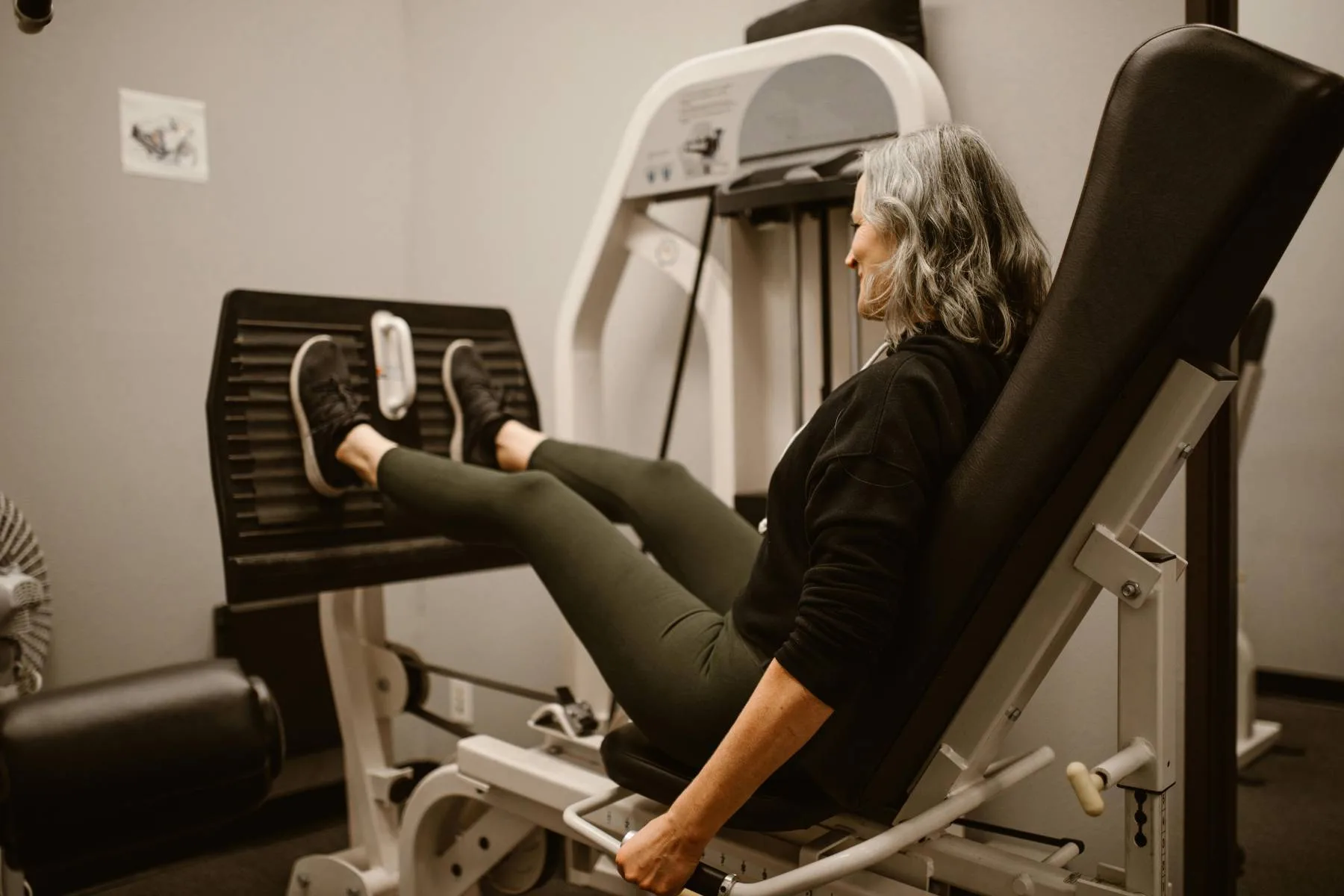
In a wall press, moving the feet changes the body angle and the load shared through the arms. In a chair rise, hands on the armrests share the work. In a hinge, a counter can reduce balance demands while the person learns the movement.
Support is a variable worth recording. If you remove it, you have changed the task even when the repetition count remains the same. Progression can mean less support, a greater load, more range, or a more relevant environment; choose the one that serves the goal.
Keep the model’s limits visible
A simple diagram can explain leverage while leaving muscle coordination, co-contraction, tissue properties, and three-dimensional motion unmeasured. A plausible mechanical explanation therefore differs from evidence that a treatment improves pain or participation.
When a programme claims to correct an alignment or unload a structure, ask how that was measured and whether the patient-important outcome improved. The evidence guide explains how to separate a mechanism, an association, and a treatment effect.[2]
Compare two ways to carry the same object
Choose a familiar lift or exercise. Record the load, its position, the support, and the speed. Make one appropriate change and compare effort and task performance. Compare the effort during the carry and whether the object is easier to handle. Return to the original setup for a later comparison.
References and evidence
- Kantak & Winstein · Learning, performance, and memory in motor skills (2012)
Retention and transfer distinguish durable learning from temporary practice performance.
- Cochrane Handbook · Interpreting results and drawing conclusions
Interpret magnitude, confidence intervals, harms, certainty, and applicability together.